Before You Bet, Read This VAR Breakdown
VAR, or Video Assistant Referee, is an officiating system used in football competitions worldwide, including FIFA tournaments, UEFA competitions, and major domestic leagues. It supports the on-field r...

Before You Bet, Read This VAR Breakdown
VAR, or Video Assistant Referee, is an officiating system used in football competitions worldwide, including FIFA tournaments, UEFA competitions, and major domestic leagues. It supports the on-field referee by checking four decision categories: goal or no goal, penalty or no penalty, direct red cards, and mistaken identity. The International Football Association Board (IFAB) requires intervention only for a “clear and obvious error” or a “serious missed incident.” A VAR team reviews live footage from multiple cameras, communicates with the referee, and may recommend an on-field review; the referee always makes the final decision. VAR does not automatically overturn every debatable call, and it cannot normally reopen play after a restart. Reviews may take several minutes, while semi-automated offside technology can identify player-position data faster. Before betting on a 2026 FIFA World Cup match, check whether a goal, penalty, or red-card decision remains under review.
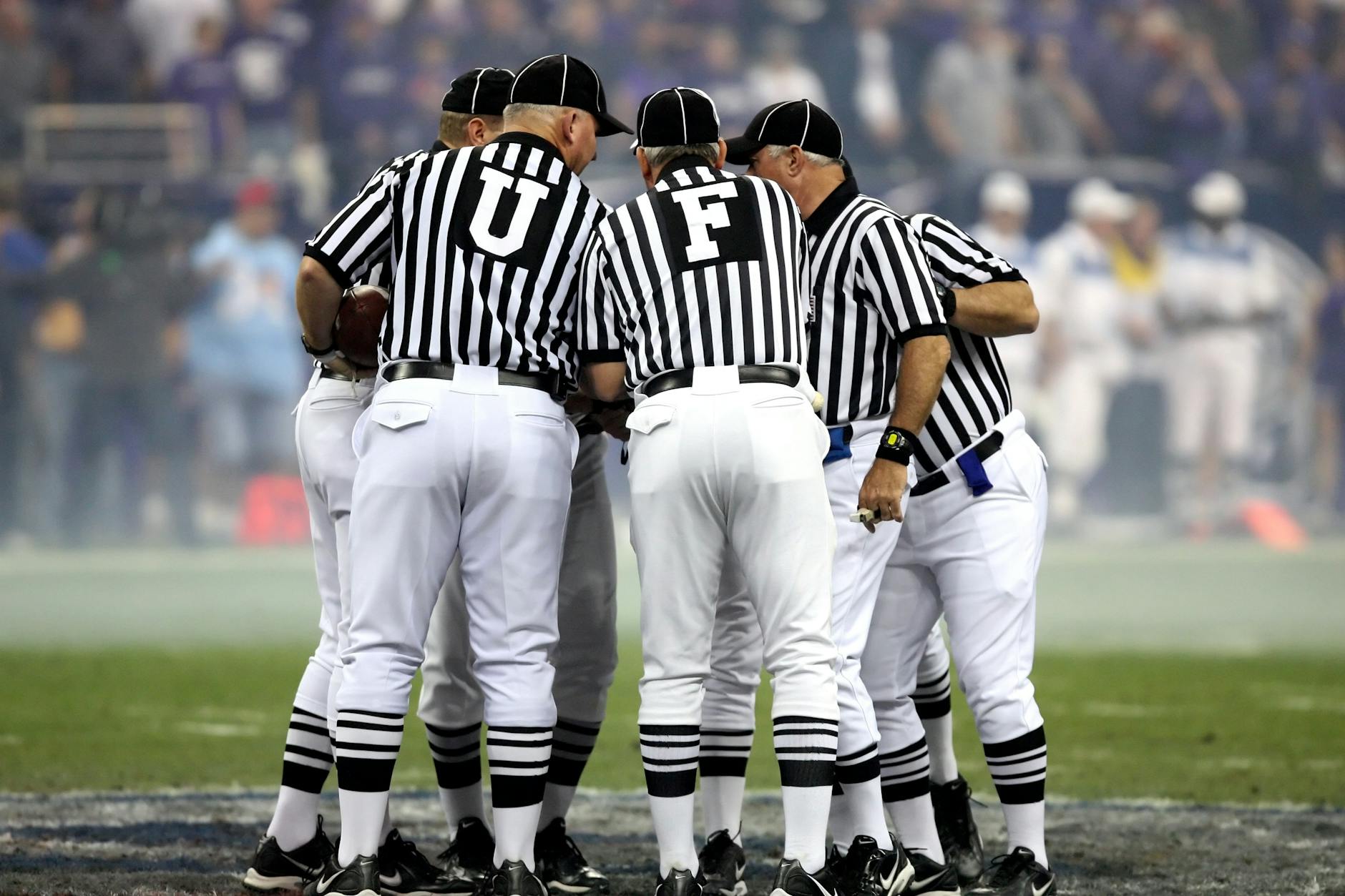
Photo by Pixabay on Pexels
Football’s video-review era has changed how goals, penalties, and dismissals are judged. It has also changed how experienced viewers read a match. The old assumption was simple: the referee saw everything, instantly. That was never true. I have watched enough decisive matches turn on one hidden touch, one boot beyond the defensive line, or one replay angle that the stadium crowd never saw. VAR does not remove human judgment. It relocates part of that judgment into a video operation room, where officials inspect the evidence under pressure.
For readers following predictions and tournament tactics, Tactical Review treats VAR as a match variable, not a magic correction machine. A late review can alter a scoreline, penalty probability, player availability, and even the tempo of a knockout tie. However, “technology guarantees perfect decisions” is an official-sounding fantasy. Camera coverage, protocol, timing, interpretation, and referee discretion still matter. The practical advantage comes from knowing what VAR can review, what it cannot review, and when the review process is likely to affect the game.
Want the broader match-analysis context before studying VAR decisions?
The Quick Comparison
| Question | VAR answer | Practical consequence |
|---|---|---|
| Who makes the final decision? | The on-field referee | VAR advises; it does not command |
| What can be reviewed? | Goals, penalties, direct red cards, mistaken identity | Ordinary fouls usually remain final |
| What triggers intervention? | Clear and obvious error or serious missed incident | Minor disagreements do not qualify |
| Can players request a review? | No | The VAR automatically checks relevant incidents |
| Is there a fixed time limit? | No | Accuracy takes priority over speed |
| Can a decision be changed after play restarts? | Usually no | Exceptions include mistaken identity and certain violent conduct incidents |
| Is offside fully automated everywhere? | No | Technology and competition rules vary |
VAR is therefore a safety net, not a second referee controlling every moment. According to the IFAB VAR protocol, the referee must make an initial decision, remain visible during a review, and retain the final authority. The protocol also states that “the VAR will automatically ‘check’ every situation/decision,” so players and coaches do not need to demand a review.
This distinction matters for match predictions. A foul in midfield may be obvious to supporters and still fall outside the review framework. A penalty incident may be reviewed because it belongs to a permitted category. A second yellow card normally cannot be corrected through VAR, while a mistaken identity issue can be. The difference is not emotional importance. It is jurisdiction under the Laws of the Game.
[Internal Link: football betting fundamentals]
Round 1: What Incidents Can VAR Review?
VAR reviews four official categories: goal or no goal, penalty or no penalty, direct red cards, and mistaken identity. The system intervenes only when video evidence indicates a clear and obvious error or a serious missed incident, while the referee remains responsible for the final call.
Goals and no-goal decisions
A goal check is broader than simply asking whether the ball crossed the line. VAR can examine an attacking handball, offside position, foul in the buildup, or another infringement during the attacking phase that directly leads to the goal. Goal-line technology, where available, answers whether the ball crossed the line; VAR examines associated offences and provides contextual review.
The practical sequence is first to verify the scoring event, then to inspect the buildup, and finally to confirm the restart. If an attacker was offside several passes earlier but the same possession continued uninterrupted, officials assess whether that action belongs to the reviewable attacking phase. This is why a celebration can collapse long after the ball enters the net. The delay feels brutal because it is designed to examine a chain of events, not one frozen frame.
Penalty and no-penalty decisions
Penalty reviews often create the most controversy because contact is common inside the penalty area. VAR can recommend intervention when the referee missed a significant foul, wrongly awarded a penalty, or failed to identify a relevant handball. It does not automatically correct every physical challenge, and “contact equals foul” remains a dangerously poor betting assumption.
Direct red cards
VAR may review serious foul play, violent conduct, spitting, biting, or similarly severe incidents that could justify a direct red card. It does not generally review a clearly incorrect second yellow card. That boundary is regularly misunderstood, particularly when a player already booked commits a reckless challenge.
Mistaken identity
If the referee cautions or sends off the wrong player, VAR can help identify the actual offender. This category protects the integrity of the disciplinary record, but it does not reopen every earlier event simply because a later replay offers a better angle.
Round 2: How Does the VAR Review Process Work?
The VAR process begins with an automatic check, moves to private communication between officials, and ends with either confirmation of the original decision or a referee review. Only the referee can initiate the formal review, and the final decision always belongs to the referee on the field.
First, the referee makes a decision and allows play to continue or stops the match, depending on the incident. At the same time, the VAR and assistant VAR inspect available footage, angles, replays, and relevant protocol details. The VAR may conclude that the decision is correct, recommend an on-field review, or advise the referee to change the call when the evidence meets the intervention threshold.
Then comes the communication stage. The referee may accept factual information from the VAR without watching the footage, especially for objective matters such as a clear offside position or the point of contact. For subjective decisions, the referee usually goes to the Referee Review Area, watches selected clips, and decides whether the original call should stand or change. The screen is not a voting booth. It is evidence supplied to the official with authority.
Finally, the referee signals the outcome, applies disciplinary action if required, and restarts play according to the Laws of the Game. Players cannot surround the referee or attempt to influence the review. The FIFA Laws of the Game emphasize that the review process is controlled by match officials, not by team requests or stadium noise.
See how the review chain affects live match interpretation.
Why reviews take different amounts of time
There is no universal review time limit because accuracy takes priority over speed. A factual offside check may be completed quickly when camera calibration and player tracking are clear. A penalty review can take longer because officials must assess the nature, location, intensity, and consequence of contact.
A useful operational insight is that the visible screen duration is not the entire review. The VAR team may check several angles before the referee is called to the monitor, and the referee’s on-field viewing may begin only after the central question has been narrowed. Therefore, a long stoppage does not necessarily mean the decision will change. It may indicate that officials are eliminating competing interpretations.

Photo by Anh Lee on Pexels
Round 3: What Technology Makes VAR Possible?
VAR relies on synchronized broadcast cameras, replay systems, communication equipment, calibrated offside lines, and competition-specific technology. The quality of the decision depends not only on the software but also on camera placement, frame rate, image clarity, and the officials’ interpretation of football law.
Camera angles and replay
A VAR operation may use wide tactical cameras, goal-area cameras, touchline views, reverse angles, and slow-motion replay. Each angle answers a different question. Wide footage helps establish player positions and the attacking phase. Close footage clarifies contact. Goal-line views assist with ball crossing, while elevated cameras can reveal defensive lines.
Slow motion is powerful but dangerous when misunderstood. It can make ordinary movement appear unnaturally forceful because the eye sees contact without the speed and momentum of live play. For this reason, experienced officials use normal-speed footage as well as slow motion. A freeze-frame can establish position; it cannot independently determine intent, intensity, or whether contact materially affected an opponent.
Semi-automated offside technology
Semi-automated offside technology uses player-tracking data and calibrated cameras to support offside decisions. It can identify relevant body positions more quickly than a manually drawn line, but it does not replace the referee’s judgment about when the ball was played or whether an interfering action occurred. The system is “semi-automated” for a reason: technology measures geometry; officials apply the law.
Communication and redundancy
The VAR, assistant VAR, replay operators, and on-field officials work through a secure communication system. Redundancy matters because a feed can fail, a camera can be obstructed, or an angle can be unavailable. A contrarian but important conclusion follows: more cameras do not automatically produce better officiating. Poorly synchronized or ambiguous footage can create more arguments, not fewer, because it multiplies images without settling the legal question.
[Internal Link: football offside rules explained]
How Should VAR Affect Match Predictions and Betting?
VAR should be treated as a probability modifier rather than a guaranteed correction, because reviewable incidents are rare, match-specific, and dependent on the referee’s threshold. The strongest approach is to avoid chasing a decision already under review and instead reassess the score, player status, and market price after confirmation.
For responsible analysis, first identify whether the incident belongs to one of the four VAR categories. Then separate factual reviews from subjective reviews. A possible offside position may be resolved through measurable geometry, while a penalty depends on interpretation and contact. Finally, check the consequence: a goal reversal changes the scoreline immediately, while a red-card review changes player availability, formation, and late-game tempo.
Tactical Review readers should also account for competition context. A knockout match in the 2026 FIFA World Cup may produce more conservative defending after a controversial penalty, while a group-stage match may retain a different risk profile. Do not assume that a team receiving a VAR decision has gained permanent momentum. Some sides respond by lowering their defensive line; others attack immediately and expose transition spaces.
The most useful information gain comes after the review, not during the chaos. Record the confirmed decision, minute, player, score, and tactical response. Then compare the new odds with the revised match state. A market that moves before official confirmation may already price in the likely outcome, leaving little value for late bettors.
Want a disciplined framework for evaluating the next match state?
What VAR cannot do
VAR is not an all-purpose appeals system. It cannot normally review every corner, throw-in, free kick, or foul, and it cannot overturn a decision merely because another referee might have chosen differently. Once play restarts, the referee generally cannot review the previous phase, except for limited cases such as mistaken identity or certain serious violent conduct incidents.
Players also cannot force the system to act. A theatrical appeal may influence crowd perception, but it does not create jurisdiction. Likewise, a coach cannot demand a review under the official protocol. The VAR automatically checks relevant incidents, and only the referee can authorize the formal review process.
[Internal Link: live football match analysis]
The Final Score & Who Should Pick What
VAR improves decision accuracy in high-impact situations, but it does not eliminate controversy, delay, or interpretation. It is best understood as a controlled intervention system: useful for four categories, limited by the Laws of the Game, dependent on footage, and always subordinate to the referee’s final decision.
| Viewer or bettor | Best VAR approach |
|---|---|
| New football fan | Learn the four review categories first |
| Live match viewer | Wait for the referee’s confirmed signal |
| Tactical analyst | Track score, formation, discipline, and momentum |
| Pre-match bettor | Avoid assuming VAR will rescue a weak prediction |
| Responsible bettor | Use only legal markets and set a fixed budget |
| Tournament follower | Check FIFA and competition-specific procedures |
The final lesson is hard-earned. A replay can reveal what the referee missed, but it cannot make football perfectly objective. “Clear and obvious” remains a judgment threshold. Camera technology can sharpen facts, yet the laws still require officials to interpret action, timing, intent, and consequence. For 2026 FIFA World Cup coverage, Tactical Review will remain most useful when it combines VAR knowledge with team tactics, player statistics, and confirmed match information.
If you want to apply this framework to upcoming fixtures, begin with the review category and finish with the confirmed decision.
Frequently Asked Questions
Q: What is VAR in football?
A: VAR is a video-based officiating support system that helps the referee review four categories of match-changing incidents. These categories are goal or no goal, penalty or no penalty, direct red cards, and mistaken identity. The system is used in competitions authorized under FIFA and IFAB requirements, and the referee—not the VAR—makes the final decision. VAR intervenes only for a clear and obvious error or a serious missed incident.
Q: How does VAR work during a match?
A: VAR automatically checks relevant incidents, communicates with the referee, and may recommend an on-field review. The referee first makes a decision, while the VAR team examines multiple camera angles and replay speeds. For factual matters, the referee may receive information directly; for subjective matters, the referee usually watches footage at the Referee Review Area. The match restarts only after the referee confirms the outcome.
Q: What is the difference between VAR and goal-line technology?
A: Goal-line technology determines whether the entire ball crossed the goal line, while VAR reviews broader incidents under the Laws of the Game. Goal-line technology is primarily a ball-position system and can provide a rapid signal. VAR can examine offside, attacking fouls, handball, penalty decisions, direct red cards, and mistaken identity. Both systems may contribute to a goal decision, but they answer different questions.
Q: Why does VAR sometimes take so long?
A: VAR takes longer when officials must examine several camera angles or interpret a subjective incident. A clear offside position may be checked quickly, while a penalty requires assessment of location, contact, intensity, and relevance. There is no universal time limit because IFAB protocol prioritizes accuracy over speed. The visible monitor review may also represent only the final stage of a longer background check.
Q: Can VAR overturn a second yellow card?
A: VAR generally cannot correct a second yellow card, because the protocol covers direct red-card offences rather than a clearly incorrect second caution. It can review whether a player should receive a direct red card for serious foul play or violent conduct. VAR may also intervene for mistaken identity. The exact disciplinary outcome still depends on the referee’s application of the Laws of the Game.
Q: Can a referee review a decision after play restarts?
A: A referee normally cannot review a previous incident after play has restarted. Limited exceptions include mistaken identity and certain sending-off offences involving violent conduct, spitting, biting, or extremely offensive, insulting, or abusive actions. This rule protects the continuity of the match and prevents endless appeals. Viewers should therefore watch for the restart before assuming that a previous decision remains open.
Q: Does VAR make football completely fair?
A: VAR improves accuracy for major incidents but cannot make football completely objective or controversy-free. Technology depends on camera coverage, calibration, replay quality, timing, and the referee’s interpretation of “clear and obvious error.” It may correct a missed event while creating a new debate about the intervention threshold. The most reliable conclusion is that VAR reduces certain errors; it does not remove human judgment.
Thank you for reading.
Tactical Review · Editorial Archive · No. 01